Can you use an AI revenue summary in your next review?
Getting a revenue figure quickly is not the same as being able to use it with confidence. What we considered when building lapal, the Sol IT ERP AI assistant: supporting data, incomplete results and access permissions.
On this page
- The revenue was right, but the answer carried a warning
- A sales query usually leads to a decision
- The ERP remains the source of the figures
- Not yet recorded is not the same as zero
- An access restriction is not a missing-data result
- The answer should connect back to existing reports
- Different languages should not mean different standards
- The business decision still needs context
The revenue was right, but the answer carried a warning
During a recent test of lapal, our ERP AI assistant at Sol IT, it returned August revenue of 42,628,000 IDR. The amount matched the income statement, yet the answer flagged it as unverified.
That is confusing for anyone using the product. We improved how it handled the case, while keeping the principle behind the warning: if the supporting evidence cannot be confirmed, the answer should make that clear.
It brought us back to a practical distinction. Getting a revenue figure from AI is not the same as being able to use it in your work.
A sales query usually leads to a decision
In retail and commerce, people rarely look up sales just to know the number. They are checking which stores need attention, deciding whether to extend a promotion, or planning the next week.
“Revenue is down on last month” is only a starting point. Are the periods comparable? Is any store data missing? Are we looking at POS sales or revenue recorded in the accounts? The definition changes how the figure should be read.
Adding AI does not remove those questions. If someone still has to reconstruct every answer in Excel and the ERP, a faster response may not save much work.
That shaped our approach. Alongside clear answers, we wanted the assistant to help people understand what still needs checking before they act.
The ERP remains the source of the figures
An LLM is useful for understanding everyday questions and explaining results. We did not give it responsibility for inventing the revenue figures. Answers use the ERP’s query results as their basis.
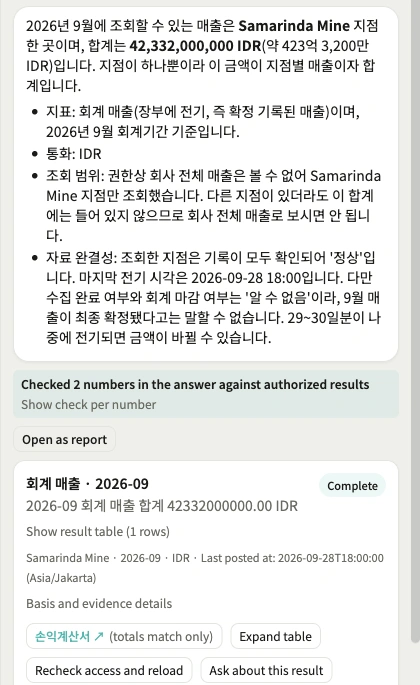
That does not eliminate mistakes. The model can still misstate an amount or a period when explaining a correct result. The answer therefore includes verification labels, with a warning when a figure cannot be verified.
“Verified” means the figure in the answer has been checked against the supporting query results. It does not certify the original entries or confirm that the month-end close is complete. Those still need the usual operational and accounting checks.
The 42,628,000 IDR example was a case where the amount was right but the supporting evidence was not sufficiently recognised. Unnecessary warnings need to be reduced. Unconfirmed answers should not look certain either. Both matter if the assistant is going to be useful day to day.
Not yet recorded is not the same as zero
Consider reviewing last month’s performance at the start of a new month. If some entries have not been posted, the figure on screen may not be the final result. Missing data and zero revenue are different things.
The assistant makes that distinction visible through statuses such as “no posted journals” and “some data missing.” These help prevent a partial result from being read as a complete total.
Before investigating a drop in revenue, teams check whether the data is sufficiently complete. We think an AI answer should support that familiar working habit, rather than skip over it.
An access restriction is not a missing-data result
When a request falls outside the user’s permissions, the assistant stops the query and explains the restriction.
Suppose a branch manager asks for company-wide revenue but can only access their own branch. Returning branch revenue instead would risk giving them a number they mistake for the company total.
Asking again is an extra step. Even so, making the access boundary clear is preferable to silently changing the scope of the question.
The answer should connect back to existing reports
When someone needs more detail, they should be able to continue in the ERP. That is why result cards can include links such as “open in income statement.”
Not every result has a link. We offer one when the destination screen can support the same figures. If only totals are comparable, the card makes that limitation clear.
The aim is not to replace the report. It is to find the relevant figures sooner, then move into the report when a closer look is needed. The assistant should fit the workflow people already use.
Different languages should not mean different standards
At an Indonesian operation, a manager reviewing results in Korean may work with colleagues who use Indonesian day to day. English may be the shared language between teams.
The assistant responds in the language of the question, including the result card’s headings and labels. It is also available through Telegram, with the same access and number-verification rules as in the ERP.
The channel or language may change. The standards behind the answer should not.
The business decision still needs context
Confirming a decline in revenue is different from deciding what to do about it. A promotion may have ended, stock may have run short, or store operations may have changed. The person responsible needs to weigh those circumstances.
A “verified” label does not validate that business judgement. Answers with warnings need another look, and important decisions still call for source data and operational context even when there is no warning.
What we want to reduce is the time spent finding and checking the information needed for that decision. Speed helps, but trust also depends on understanding what supports the answer and what still needs attention.
If you are considering AI for your ERP or POS data, we can explore it with you at lapal. We start with the systems you already use and the checks your team repeats, then look for where an assistant would genuinely help.
Considering AI for your ERP or POS data?
Tell us which systems you use and which checks your team repeats. We will look with you at where an assistant would genuinely help.
Talk to us about AI